

Ask an arcade operator how do UFO catchers work, and the answer usually skips the claw. The grab is the last step of a cycle that starts at the control board, runs through drive motors and a winch, and ends with a payout decision the player cannot see.
Operators ask a different question: which settings make the machine earn, and which ones quietly lose money. If the general picture is new, our guide to how claw machines work covers the shared basics; this article goes deeper into the two-claw design, settings, and payout logic.
Core Components Inside the Cabinet
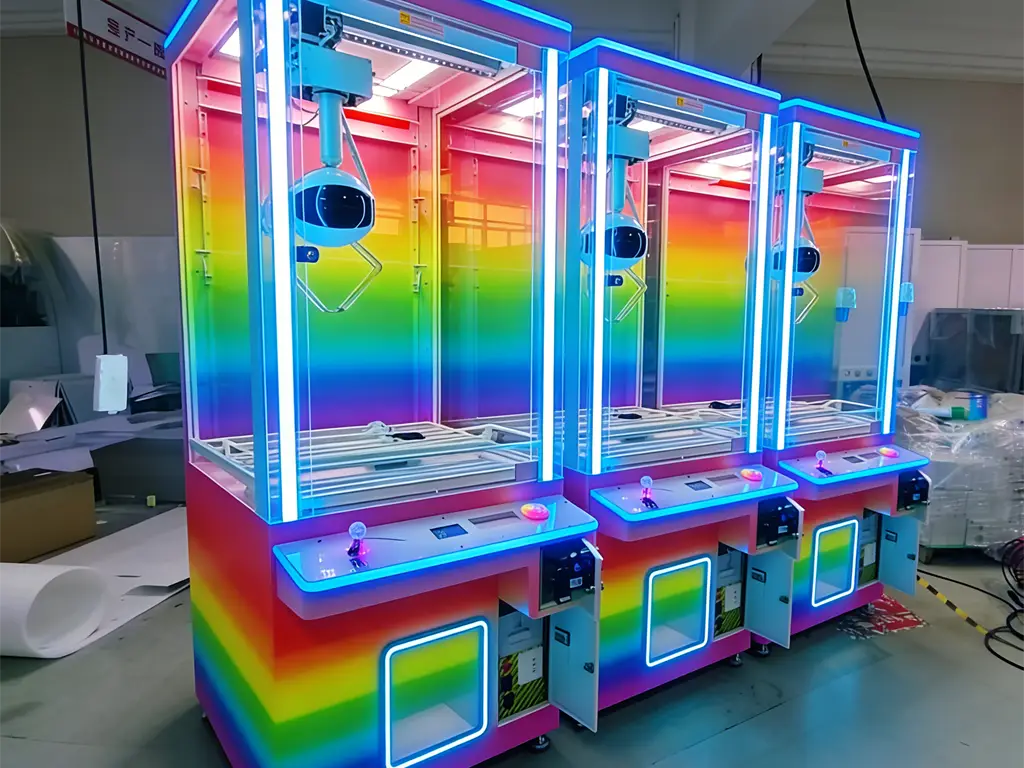
Behind the glass sits a compact chain of hardware; each piece bounds what the next one can do.
Gantry Rails and Axis Drive Motors
The gantry is the moving frame that carries the claw above the prize bed. Two axis drive motors move it: one drives the carriage along the front-to-back rail, the other across the left-to-right rail. On a UFO catcher, those are the two directions the player controls, which is why the cabinet needs only two buttons. Each axis carries a home sensor, so the control board reads the carriage position after every power-up instead of assuming it.
Rails matter more than they look. A rail that is bent, dirty, or out of parallel returns the claw to the wrong spot, and the prize lands on the glass instead of in the chute. Check rail alignment at delivery, then again when a machine starts missing the chute after months of play.
Winch, Cable, and Claw Assembly
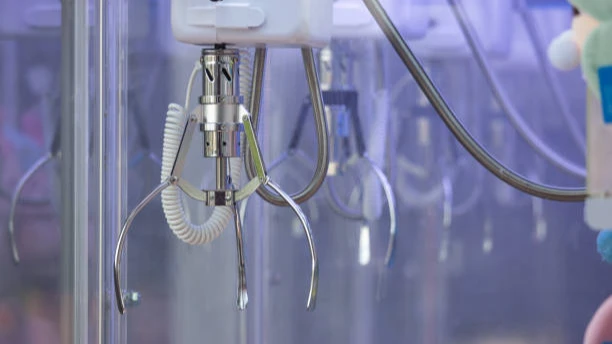
The winch is a geared motor that spools the cable holding the claw. The drop is gravity; the lift is the winch. At the end of the cable sits the claw assembly: two prongs driven by a solenoid, closed when the coil energizes and sprung open when power cuts.
The cable takes repeated shock loads and fails without much warning. A stretched cable slows the lift and shifts where the claw hangs; a snapped one drops the claw into the prize bed mid-game. Order spare cables with the machine and replace them on a play-count schedule rather than by eye.
Control Board and Prize Sensors
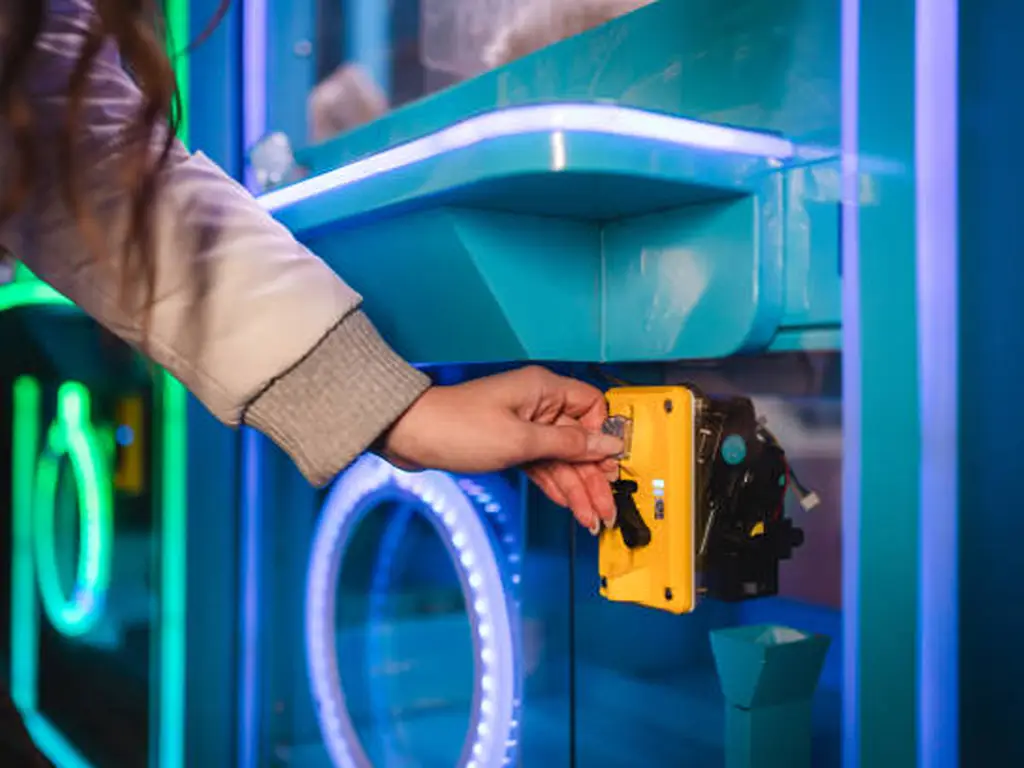
The control board holds the machine’s logic: the strength values, the price per play, and the payout counter that decides how often the claw grips at full force. A prize sensor at the chute — an optical sensor or a switch — registers each prize that lands, confirms the win, and resets the cycle.
A dirty or misaligned sensor breaks the math in both directions. It can count a win that did not land, resetting the payout cycle early, or miss a real win and leave the counter stuck. Either fault pushes the win rate off the operator’s setting. For a part-by-part map of everything from the coin door to the claw, Nostro parts of a claw machine guide covers the full cabinet.
Components set the limits; the control sequence sets the game. The two-button layout looks trivial, but its rules shape everything a player can do.

The Two-Button Control Sequence
Every play allows a single press per direction; tempismo, not repositioning, decides where the claw lands.
The classic Sega UFO Catcher runs on two buttons and one strict rule: each button can be pressed once per play. Press and hold the forward button, and the carriage rides toward the back of the cabinet; release it, and that depth locks in. Press and hold the right button, and the carriage moves across the cabinet; release it, and the claw drops. There is no confirmation step, no repositioning, and no second chance.
After the lift, the carriage travels home and opens the claw over the prize chute in the front-left corner. Timing is the entire skill: two blind decisions, then the machine takes over.
Per gli operatori, the sequence is also a spec item. The one-press rule depends on clean microswitches under each button — a worn switch double-fires or fails to register, and the play ends before the player positioned anything. Ask whether the supplier ships spare switches, and test the button feel during the demo.
The two-button sequence works because the machine does not expect players to grab and carry. It expects push, lagna, and roll — and that expectation is built into the claw.
Two-Claw Versus Three-Claw Grip Design
Prong count changes how prizes are held, caught, and lost — geometry matters before any voltage does.
Prong Count and Grip Surface
A two-prong claw closes like a pair of tongs. The prongs meet along one pinch line and hold the prize at two contact points. A three-prong claw closes three fingers toward a center point, cradling a round plush from three directions. Two prongs cover less surface — and on the Japanese-style UFO catcher, two prongs are the standard.
Why Two-Prong Claws Grip Less
Hold a soft ball with two fingers, then with three. The two-finger grip lets the prize rotate around the pinch axis and slide free under its own weight, especially during the stop-and-start of the return trip. Three fingers resist that rotation. The coil can be identical in both designs — the difference is geometry, not power. Two-claw machines grip less by construction, and players read that weaker grip as a harder game. Operators should read it as a prize specification: heavy, smooth, or long prizes fall out of a two-prong grip on the way home.
Push, Drag, and Roll Prize Physics
Skilled players on a Japanese two-claw cabinet rarely lift a prize straight up. They hook a seam or a tag with one prong, drag the prize across the bed, and roll it over the edge into the chute. The claw works as a hook, and the win becomes a physics problem: where the prize sits, what the prong can catch, which way it rolls. That is the design’s intent — a fixed-strength machine where every play performs the same and the player’s plan makes the difference. Per gli operatori, that means merchandising: leave a catchable edge on the pile, keep the bed near the chute busy, and the machine earns on play count rather than one big lift.
Claw design decides what the grip can do. The voltage settings decide what it does on any given play — and two small adjustments explain most of what players call “the machine cheated.”
Claw Strength and Voltage Settings
Grip force is an electrical decision first: the coil only squeezes as hard as the board tells it to.
Coil Voltage and Potentiometers
Grip force comes from a solenoid coil, and the force scales with the voltage the board sends to it. Operators adjust that voltage through potentiometers on the control board — screw-type trim pots set during service. A potentiometer programs nothing; it sets a level the board then applies to the coil. Two machines with identical parts can grip differently; one machine grips differently after someone nudges a pot. Mark the factory settings before you change anything.
Lift Strength Versus Travel Strength
On well-built boards, two potentiometers split the grip into two phases. The first sets lift strength, the force through the rise and the return trip. The second sets travel strength, the grip applied as the carriage moves toward the prize chute. Arcade experts describing real machines put it plainly: the travel pot is commonly set below the lift pot. That gap is the mechanism behind the classic moment when a prize survives the whole lift and drops on the final stretch : the machine tightens for the rise, loosens on the approach to the chute. If wins keep dying at the last meter, check the travel strength pot before blaming the claw.
Calibrating for Prize Weight
Calibration starts with the heaviest prize in the cabinet, not the average one. Set lift strength so the claw holds that prize through the full rise and return, then set travel strength to shape how many of those carries finish. The two values set the honest win rate before the payout counter gets involved. The sequence:
- Weigh the heaviest prize the cabinet will hold.
- Raise lift strength until that prize survives a full lift and return cycle.
- Set travel strength below lift strength, then run a fixed block of test plays and log the wins.
- Compare the logged win rate with your target, adjust in small increments, and re-test.
If a board exposes a single strength pot, the last-meter drop cannot be tuned separately — a real limitation to weigh when comparing machines. Our explainer on what double clamp means on a claw machine walks through how two-stage grip settings work on the claw itself.
Strength is the hardware half of win control. The software half is the payout counter — the number to set first and check most often.
Payout Logic and Win Rate Programming
How often the claw grips at full force is a number set on the board — and it drives the revenue.
How One-in-N Payout Cycles Work
A payout cycle runs on a counter. The board tracks plays since the last prize landed: a paying play commands full grip, every other play commands the reduced grip set in the pots. Set the machine to pay out once in five, and the board spreads full-strength attempts across the next five plays. Operators commonly run payout rates of 10–30% — roughly one paying play in ten at the low end, one in three at the high end. Players see the same two-button sequence every time; the grip is what changes.
Setting Payouts to Prize Cost
The counter should be set from the prize’s replacement cost, not from habit. The working example arcade operators use: UN $10 prize on a $1 play pays out roughly once every 15 Play. IL $15 collected covers the $10 prize and leaves $5 before overhead. Shorten the interval and the prize eats the take; stretch it and play counts slide. Recalculate when the prize mix changes; a new plush at a different cost quietly breaks the old interval.
Fixed Strength Versus Payout Machines
The two-claw market splits into two philosophies. Japanese-style machines run fixed strength: the same grip on every play, with the win coming from the player’s push-drag-roll skill. Western machines lean on payout programming: the grip changes across the cycle, and the win rate is a business decision. Neither design hides what it is — the fixed machine is consistent per play, the programmed machine is consistent per cycle. Match the machine to the market you run: skill-focused players expect the Japanese model, casual locations need the programmed one. How those settings shift player behavior and revenue is its own subject, covered in our guide to claw machine settings and player behavior.
| Setting | What it controls | Common range | What to check |
|---|---|---|---|
| Payout rate | Share of plays that apply full grip strength | 10–30% of plays | Set from prize cost, not habit |
| Lift strength | Grip through the rise and return trip | Set per prize weight | Holds the heaviest prize through the full lift |
| Travel strength | Grip on the approach to the chute | Commonly set below lift strength | Explains last-meter drops; tune it last |
| Price per play | Revenue per credit | $1 in the working example | Recalculate the payout interval when it changes |
| Costo del premio | Cost of replacing each payout | $10 in the working example | Drives the one-in-N target |
Settings decay in the field. What the operator programmed on day one is only as good as the parts still doing their jobs.

Operator Upkeep and Monitoring
What earns the machine is attention, not luck — routine checks keep the programmed numbers honest week after week.
Weekly numbers reveal more than a monthly teardown. Log plays, wins, and revenue, and watch the win rate against the payout rate you set. When the win rate drifts, suspect a part before the program: a prize sensor that missed a win and kept the counter running, a cable that stretched, a pot that vibrated off its mark. The board does what it is told; the drift usually sits downstream of it.
The service checklist is short. Clean the chute sensor so every payout registers. Check the button contacts, because the one-press sequence depends on them. Inspect the cable at the winch drum, where wear concentrates. Keep spare parts on the shelf instead of ordering mid-outage.
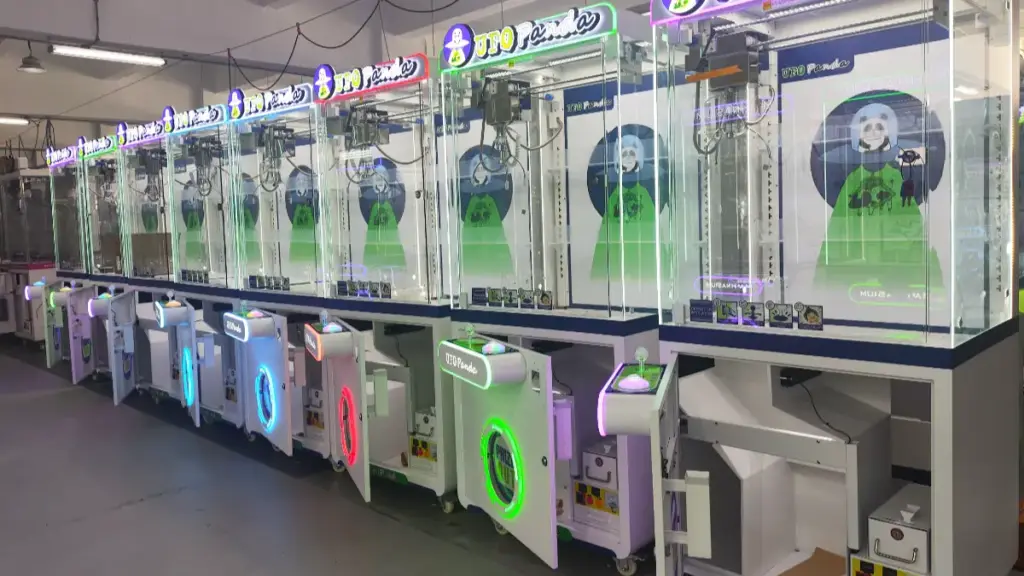
Buying decisions set the upkeep burden in advance, so ask what the supplier supports after delivery. Tongru’s UFO catcher boards are developed in-house around imported ICs, its hot-selling models run on fully automated production lines, and the after-sales package is a one-year machine warranty, manutenzione a vita, and paid spare-part shipping. Delivery runs within 30 working days of contract signing — put that in the contract, not the sales chat.
Board quality and support terms vary across suppliers, so compare them by spec and by service record. The single-player machines in the UFO catcher category are a starting point for checking board, garanzia, and spare-part terms side by side.
Every part of a UFO catcher is adjustable, and every adjustment shows up in the numbers within a week. The machines that earn are the ones whose settings were chosen, not inherited.
Pensieri finali
A UFO catcher earns only when its three controls — mechanics, voltaggio, and payout — agree with each other.
How do UFO catchers work? Two mechanical decisions and one setting. The two-prong claw and two-button sequence push play toward push-drag-roll, while the payout counter decides how often the grip runs at full force. Set the counter first — prize cost into play price — then calibrate the pots to the heaviest prize and watch the win-rate log weekly. If your floor plan, prize weights, and target payout rate are ready, Tongru’s UFO catcher category is the next stop: those three numbers are what its configuration starts from.
Most operators arrive at the same questions before changing a setting or signing a purchase order.
Domande frequenti
How do claw machines decide when you win?
The control board’s payout cycle decides. It counts plays and applies full grip strength on programmed paying plays — operators commonly set that share at 10–30% of attempts.
What is a payout rate on a claw machine?
The share of plays in which the claw applies full grip strength. UN 10–30% rate means roughly one paying play in three to ten, spread through the payout cycle.
Can arcade owners change claw strength?
SÌ. Strength is set through potentiometers on the control board, and boards with two pots split lift strength from the travel strength used on the approach to the chute.
Why do claw machines drop prizes right before the chute?
Because travel strength is commonly set below lift strength. The claw holds through the rise, then loosens on the final approach to the chute.
Do UFO catchers use a joystick or buttons?
Pulsanti. A classic UFO catcher uses two — one for forward, one for right — each pressable once per play; releasing the second button drops the claw, and the carriage returns to the front-left chute.
How often should an arcade machine pay out?
Set it from prize cost. Con a $10 prize and a $1 giocare, roughly one payout every 15 plays covers the prize and leaves margin before overhead.